New Formula Interface Available!
Version 2.0 introduces a modern formula-based
interface similar to lm() and plm().
For the new interface, see
vignette("formula-interface"). This vignette demonstrates
the classic matrix-based interface, which remains fully supported.
Quick comparison:
# Classic interface (this vignette)
setup <- panel.matrices(california_prop99)
result <- synthdid_estimate(setup$Y, setup$N0, setup$T0)

# New formula interface
result <- synthdid(PacksPerCapita ~ treated,
                   data = california_prop99,
                   index = c("State", "Year"))
Both interfaces produce identical results!
Example use
We estimate the effect of California Proposition 99 on cigarette
consumption using the classic matrix-based interface.
For the modern formula interface, see
vignette("formula-interface").
Standard Errors
We have only one treated unit (California), so the only implemented method to estimate the standard error is the ‘placebo’ method described in Section 5 of Arkhangelsky et al. Because this is not trustworthy, it is not used by default: vcov instead returns NA. Here it is probably too large.
But to show how confidence intervals are constructed and displayed, we’ll use it anyway. To do this, we pass method=‘placebo’ to vcov and pass se.method=‘placebo’ to our plotting functions so they do the same. If we didn’t, the plots wouldn’t show have standard errors.
data('california_prop99')
setup = panel.matrices(california_prop99)

tau.hat = synthdid_estimate(setup$Y, setup$N0, setup$T0)

tau.hat
#> synthdid: -15.604 +- NA. Effective N0/N0 = 16.4/38~0.4. Effective T0/T0 = 2.8/19~0.1. N1,T1 = 1,12. [NOT CONVERGED]
print(summary(tau.hat))
#> Treatment Effect Estimate:
#>         Estimate
#> treated    -15.6 NA NA NA
#>
#> Dimensions:
#>                          Value
#>  Treated units:           1.000
#>  Control units:          38.000
#>  Effective controls:     16.388
#>  Post-treatment periods: 12.000
#>  Pre-treatment periods:  19.000
#>  Effective periods:       2.784
#>
#> Top Control Units (omega weights):
#>               Weight
#> Nevada         0.124
#> New Hampshire  0.105
#> Connecticut    0.078
#> Delaware       0.070
#> Colorado       0.058
#>
#> Top Time Periods (lambda weights):
#>      Weight
#> 1988  0.427
#> 1986  0.366
#> 1987  0.206
#>
#> Convergence Status:
#>   Overall: NOT CONVERGED
#>   Lambda:  ✗ (10000/10000 iterations, 100.0% utilization)
#>   Omega:   ✗ (10000/10000 iterations, 100.0% utilization)
#>
#>   Recommendation: Consider increasing max.iter or relaxing min.decrease.
#>   Use synthdid_convergence_info() for detailed diagnostics.

se = sqrt(vcov(tau.hat, method = 'placebo'))
sprintf('point estimate: %1.2f', tau.hat)
#> [1] "point estimate: -15.60"
sprintf('95%% CI (%1.2f, %1.2f)', tau.hat - 1.96 * se, tau.hat + 1.96 * se)
#> [1] "95% CI (-32.53, 1.33)"
The parallel trends plot.
We show the trajectories of California and the synthetic control we compare it to, with a vertical line indicating onset of treatment. The relative size of the weights for pre-treatment periods are shown on the bottom. Overlaid is a diagram of the estimate.
The Parallelogram
The blue segment shows the change from the weighted pre-treatment average to the post-treatment average California. The red one does the same for a synthetic control.
The Hallucination
Our premise is that, absent treatment, California would change like the synthetic control: from California’s pre-treatment average, we draw a dashed segment parallel to the control’s red one. Where it ends is our estimate of what we’d have observed in California had, contrary to fact, it not been treated.
The Treatment Effect
Comparing this counterfactual estimate to what we observed in the real world, we get a treatment effect. We show it with a black arrow. We show a 95% confidence interval with two gray arrows: one for the upper confidence bound and one for the lower.
plot(tau.hat, se.method='placebo')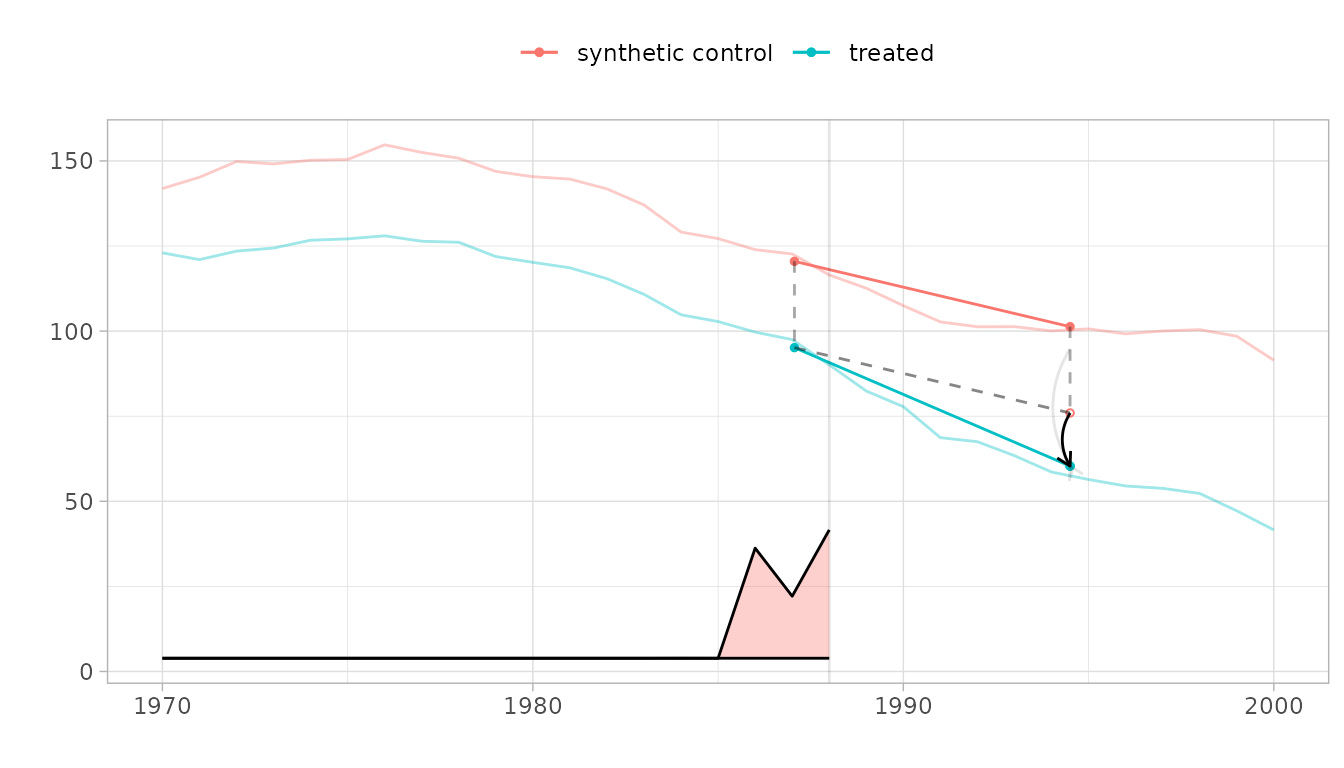
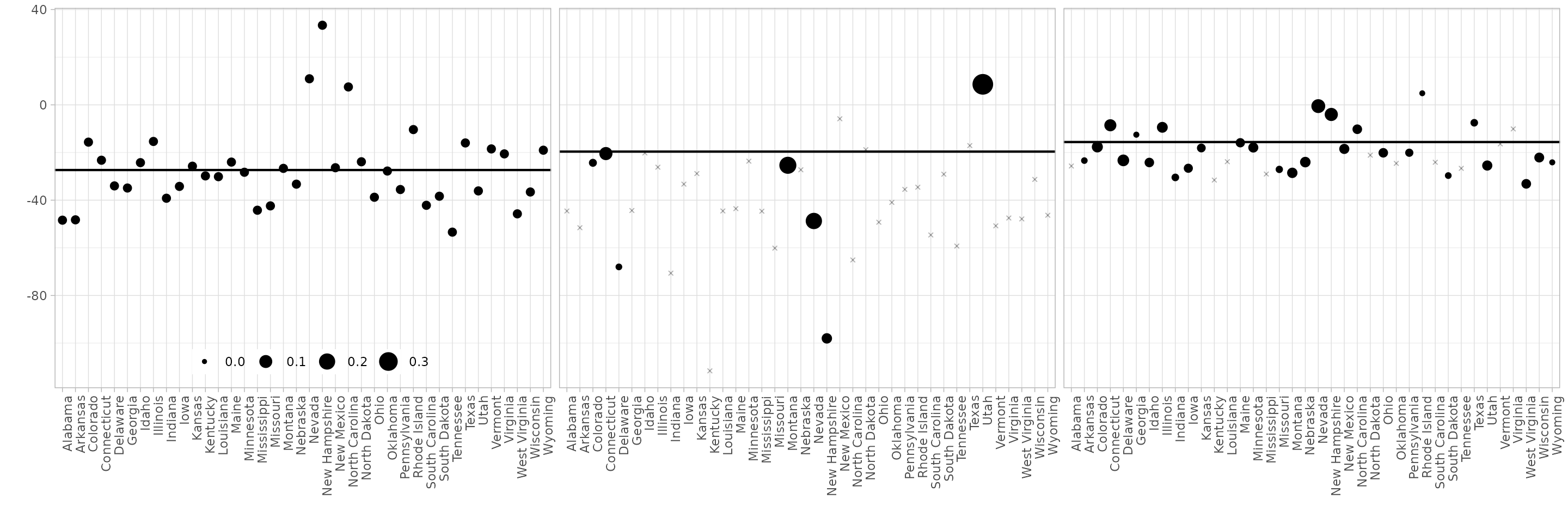
The control unit contribution plot.
We could draw the plot above, and get a questionable treatment effect estimate, by comparison to any individual control state. Our actual estimate is a weighted average of these: the weights are the synthetic control weights . This plot shows each individual comparison with a dot, with weight determining the dot size. The black horizontal line shows the actual effect; the gray ones show the endpoints of a 95% confidence interval.
synthdid_units_plot(tau.hat, se.method='placebo')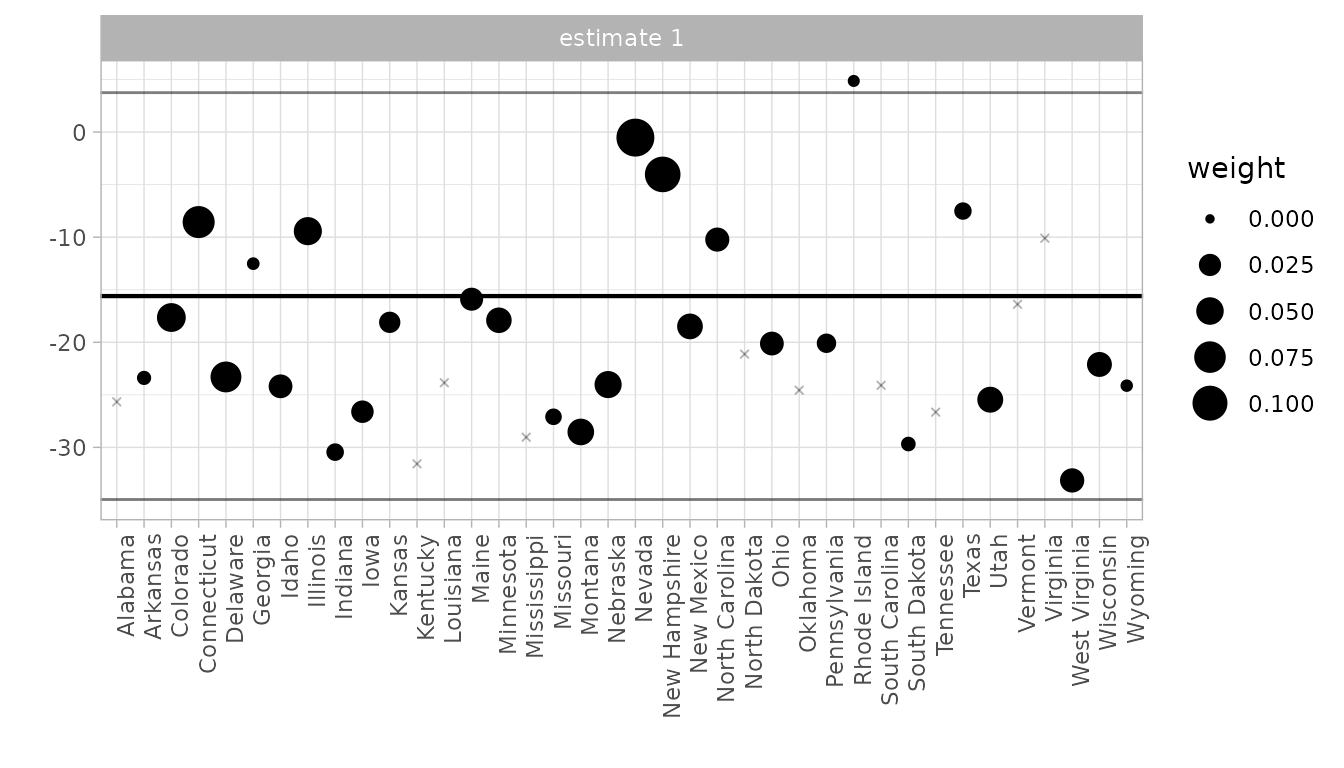
Checking for pre-treatment parallel trends
When the synthetic control and treated trajectories are far from one another, it can be hard to see how parallel they are. Pass overlay=1 to plot to overlay them.
plot(tau.hat, overlay=1, se.method='placebo')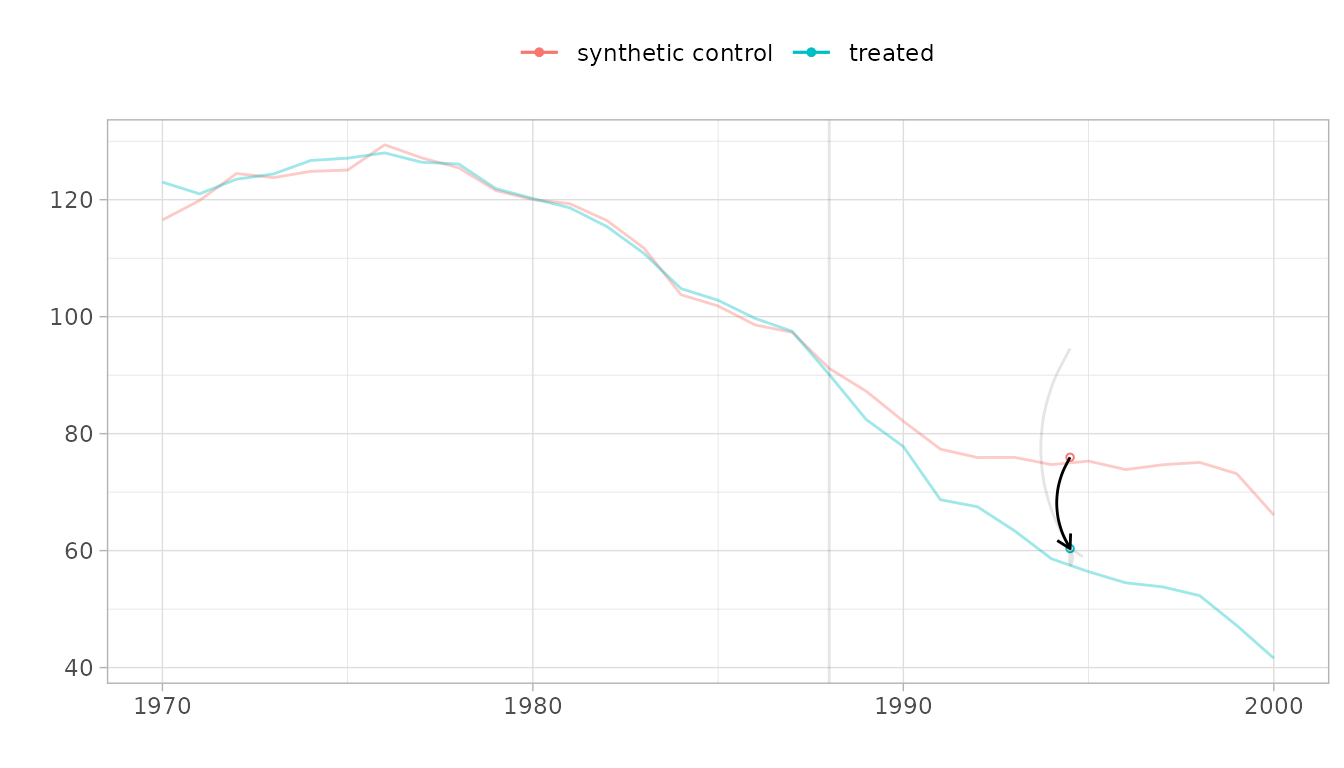 Pass values between zero and one to shift the control’s trajectory
toward California.
Pass values between zero and one to shift the control’s trajectory
toward California.
plot(tau.hat, overlay=.8, se.method='placebo')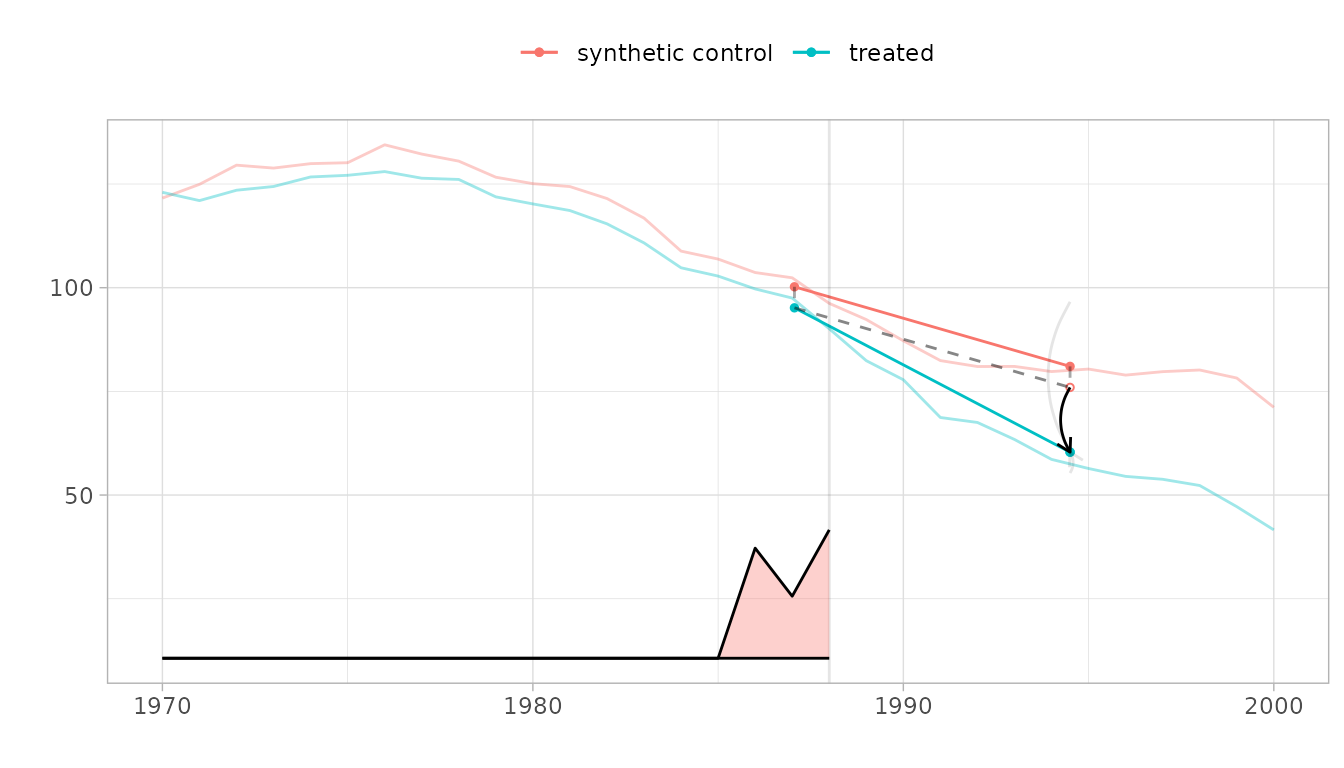
Compare to other estimators
We compare to synthetic control and diff-in-diff.
tau.sc   = sc_estimate(setup$Y, setup$N0, setup$T0)
tau.did  = did_estimate(setup$Y, setup$N0, setup$T0)
estimates = list(tau.did, tau.sc, tau.hat)
names(estimates) = c('Diff-in-Diff', 'Synthetic Control', 'Synthetic Diff-in-Diff')
print(unlist(estimates))
#>           Diff-in-Diff      Synthetic Control Synthetic Diff-in-Diff
#>              -27.34911              -19.61966              -15.60379
synthdid_plot(estimates, se.method='placebo')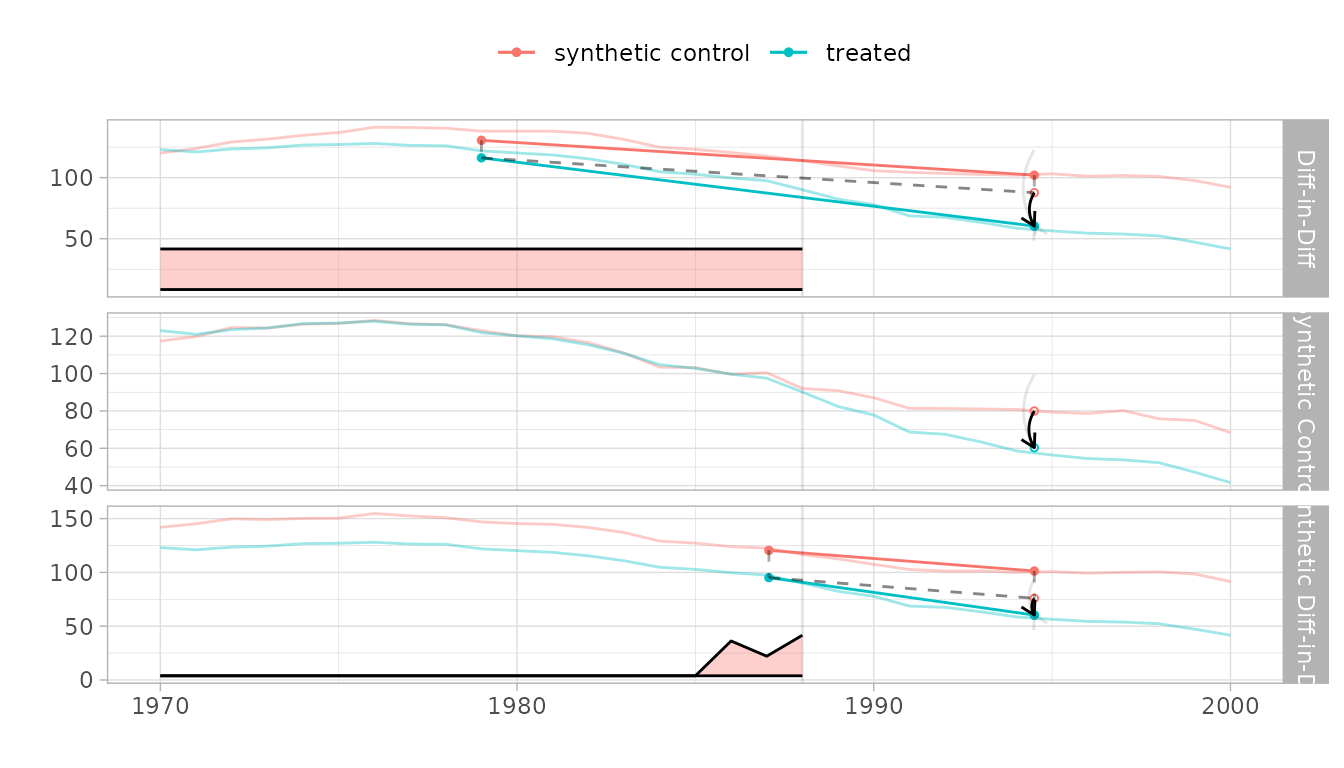
synthdid_units_plot(estimates, se.method='placebo')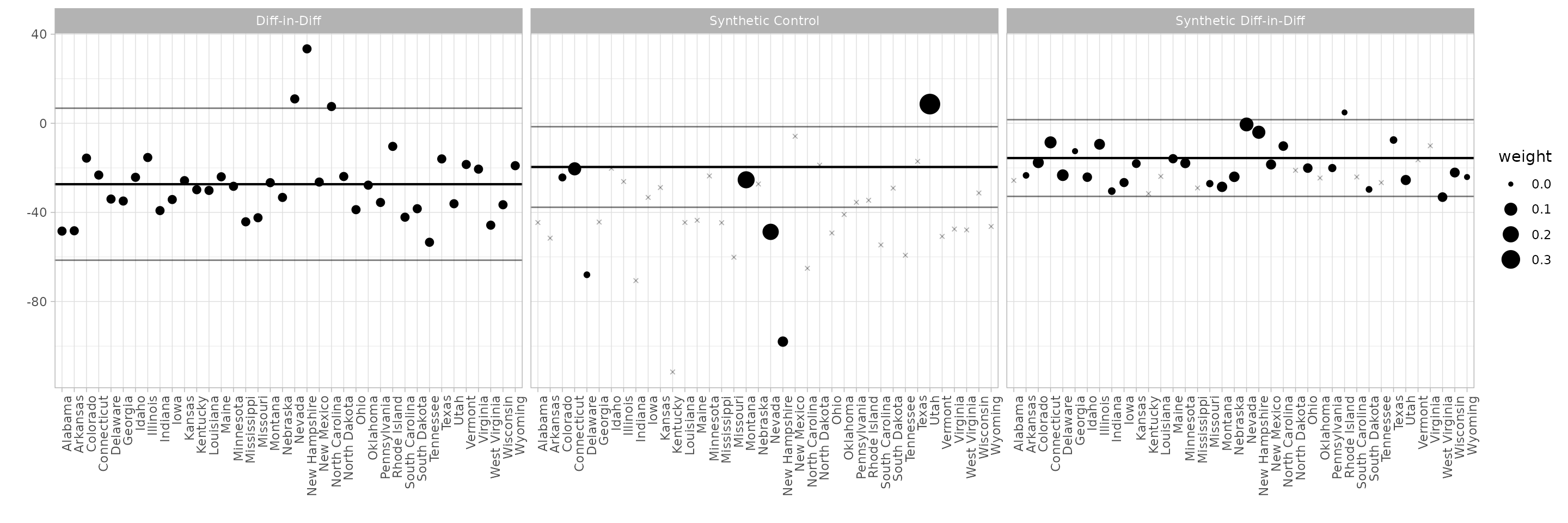
Customize plots
Arguments to plotting functions can change the transparency, line thickness, etc. of individual elements. The output of every plotting function is a ggplot, so you can change theme, legend position, etc. as usual. We’ll use these to match the style of Figure 1 in Arkhangelsky et al.
synthdid_plot(estimates, facet.vertical=FALSE,
              control.name='control', treated.name='california',
              lambda.comparable=TRUE, se.method = 'none',
              trajectory.linetype = 1, line.width=.75, effect.curvature=-.4,
              trajectory.alpha=.7, effect.alpha=.7,
              diagram.alpha=1, onset.alpha=.7) +
    theme(legend.position=c(.26,.07), legend.direction='horizontal',
          legend.key=element_blank(), legend.background=element_blank(),
          strip.background=element_blank(), strip.text.x = element_blank())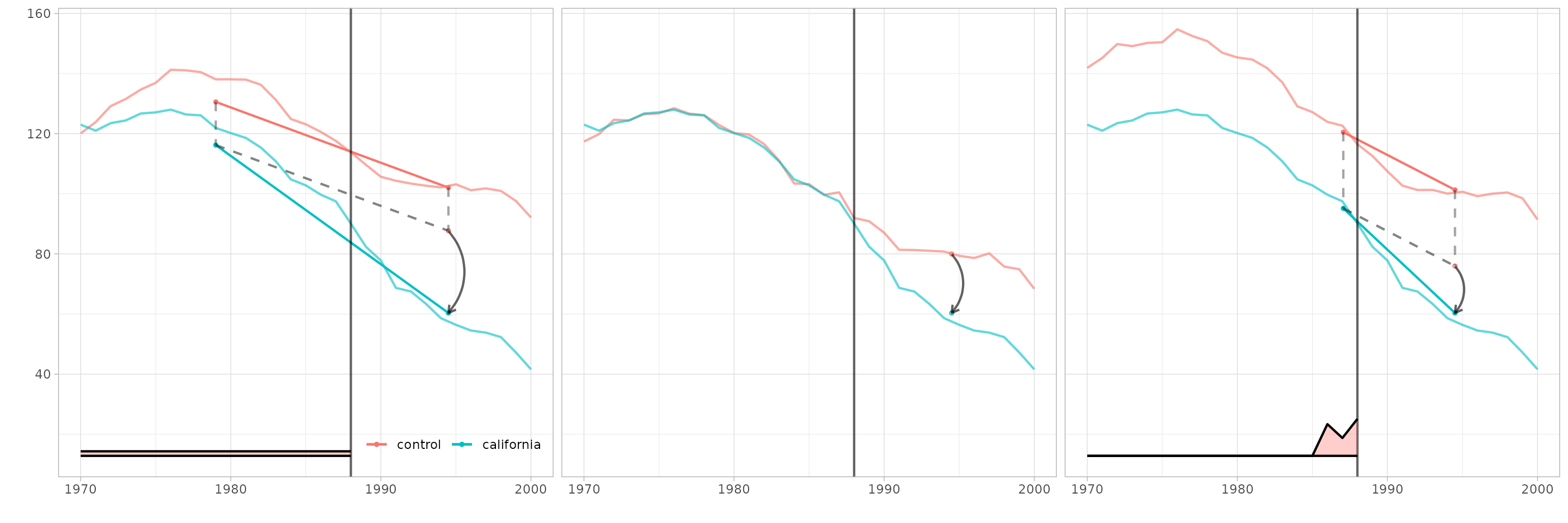
synthdid_units_plot(estimates, se.method='none') +
    theme(legend.background=element_blank(), legend.title = element_blank(),
          legend.direction='horizontal', legend.position=c(.17,.07),
          strip.background=element_blank(), strip.text.x = element_blank())